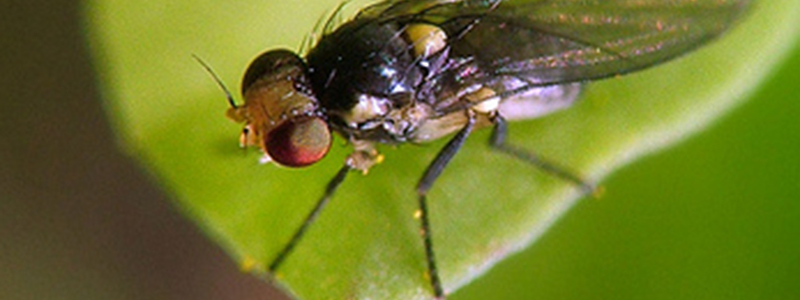
A seemingly small fly can cause visible damage in vegetable and floriculture in a short period of time. The leaf miner is known for the typical swinging gaits in the leaves, with direct consequences for photosynthesis and product quality. Especially in crops where leaf quality determines market value, degradation can have a rapid economic impact.
Miner flies mainly belong to the genus Liriomyza. They are small, yellow-black flies, a few millimetres in size. It is not the adult insect that causes the most damage, but the larva.
After laying an egg in the leaf tissue, the larva develops between the upper and lower skin of the leaf. During demand, characteristic, winding tunnels are created. After the larval phase, the insect pupates in or on the ground, after which a new generation is created. Several generations per year can develop in greenhouses.
Damage is visually visible and consists of:
The minerals interfere with photosynthesis. In leafy crops, this immediately leads to a loss of quality. In fruit vegetables, infestation can weaken the plant, which indirectly affects production and uniformity.
Infestations occur in both greenhouses and open ground, including:
Leafy crops and floriculture crops with a high aesthetic value are particularly susceptible to economic damage.
Miner flies develop rapidly at higher temperatures. In greenhouses with a stable climate, the population can build up continuously. Factors that contribute to rapid spread:
Early signaling is essential to limit population growth.
Control consists of a combination of monitoring, cultivation measures and physical protection.
Using chemical plant protection products is possible, but it is under increasing pressure due to changing laws and regulations. In addition, resistance management requires a thoughtful approach.
That is why the focus is increasingly shifting to integrated and preventive measures.
One of the most effective ways to limit leaf miner flies is to use leaf miners in air windows and façade ventilation.
Important points of attention when it comes to leaf miner netting:
Ornata Plus 80 leaf miner screen is most commonly used as a direct crop cover. It forms a physical barrier and contributes to a more stable pest pressure. This supports an integrated cultivation strategy where subsequent correction is less necessary.
In addition to physical effects, monitoring remains important. Yellow sticky traps provide insight into the presence of adult leaf miners. Regular crop inspection enables early detection of miners.
An integrated approach combines:
Combining multiple measures creates a more stable cultivation system with less risk of sudden outbreaks.
Miner fly is a small pest with potentially major consequences for yield and quality. The recognisable drawbacks make damage visible, but effective control requires a structural approach.
By investing in appropriate insect screen solutions, accurate monitoring and an integrated strategy, more control over inflight and population development is created. Physical insect protection is a forward-looking basis for resilient cultivation systems.